Showing posts with label about me. Show all posts

Monday, 27 July 2015

I ain't dead yet

Title with apologies to Woody Guthrie.

Very much alive and very busy, but decided to resuscitate the blog, at least until I have a website up and running (I will get to grips with it one day, I promise)

Busy making quilts for exhibitions.  The Cwilt Cymru quilts in the last post (about 19 months ago) have been to Redditch (Forge Mill Needle Museum), Llanidloes (Minerva gallery), and Rhyl Art Gallery, and will also be shown at the Pierhead Gallery in Cardiff (yes we're impressed too!) in November, after which they will tour with Grosvenor Exhibitions.  Work for the next exhibition is currently under way - watch this space.

In September, the Etcetera group, of which I am a member, has its first exhibition at the Platform Gallery in Clitheroe - 14th to 26th September.  If things work out I will have two quilts plus some small pieces on exhibition, space permitting.  The them is transitions, and the pieces I am exhibiting focus on transitions in my life.  This includes the quilt already shown as part of the last Contemporary Quilt Dislocation exhibition:
 
This quilts was made after coming to terms with my husband's alcoholism, which caused his death.  After dealing with the issues described in my last post I decided that I didn't want to struggle with this on my own, and luckily found an excellent therapist who helped me deal with it.  This included writing letters to my husband's demons, which I did in huge letters on the walls of a room due for redecoration, and wallpaper which I then proceeded to strip off.  It occurred to me that the words, disguied by being written in different directions, would make interesting fabric.  Painted, handwritten and screen-printed fabrics formed the basis of the quilt, which was then cut back to allow the red silk shape through - just as the process of writing the letters had allowed me to see him again and to grieve for him which I had not done properly before.  The quilt, Letters to the Demons will be accompanied by three mixed media pieces, combining painted canvas, fabric and stitch,  Anger, Recrimination and Resolution.  The last was finished first, possibly because it describes where I am now:
 
 
The other two pieces - more painful to produce because I needed to go back there to do it - will be completed shortly.
 
I did promise to make cheerful quilts this year - and at last this has happened.  The second quilt, in the process of being made, is called Moving On, and is about the realisation that I now have to leave the past behind and focus on my life now and in the future.  It relates to a recent walk in Northumberland along the coast between Craster and Beadnell.  In the earlier part of the walk I recollected the past, and felt acutely the lack of someone to share the walk with but by the time I reached Football Hole, I realised that my husband's alcoholism had, by our last visit to the area, made that sharing impossible, and that there was a sense that I was clinging to an illusion: anything that was to happen in the future would be a different kind of life.  Maybe in some ways a hard-won realisation, but one which enabled me to finish the walk in a much happier frame of mind, in the company of numerous black-headed gulls, terns and only a few - very civilised - people.  Even getting wet up to the knees crossing Long Nanny (the stream that runs into the sea) was fun - at least until I realised that walking in wet socks and boots might mean blisters, and I really should have taken off my boots and socks - but after deciding to get a bus rather than walk the last few miles to Seahouses I was able to encounter two brown hares (or maybe the same one getting around a bit) in Beadnell village...
 
The resulting quilt is well on the way to completion.  Reference to Beadnell beach and walking across Long Nanny - but with conmplete disregard for geographical accuracy (artistic licence here):
 
 
This is only a detail, not the whole quilt, which is currently being quilted, but it does give some idea of the joyfulness of it, the bright colours, the strange sgapes and so on,  The two fabrics are dye-printed, the blueish one from my husband's shoes (it turned out to be a good ides to keep them after all) and the red and yellow one a version of my own footprints (I tried printing from my own feet but it just looked blobby and I ended up with yellow feet for a few days).  It's even brighter than the picture suggests and I hope people will smile as much as I do when they see it.  It has been and is being so much fun to make and is possibly the most joyful thing I have ever done.  And judging by the smiles on the faces of Ryedale Embroiderers Guild members, who I showed it to when I gave them a talk on Saturday,  it may convey that sense of enjoyment to other people.  I hope so! 

Monday, 10 February 2014

Connection at Forge Mill Needle Museum

Last year I was fortunate enough to be selected as a guest artist for Cwilt Cymru, a group whose work I had admired since seeing it in the Spirit of the Celts exhibition.  The theme of the current exhibit is Connection, and I have chosen the connection with my mother as the focus of what I produced.  Since my mother's side of the family is entirely Welsh it seemed appropriate and I had been planning a series of pieces on my relationship with my mother for some time.
 
The first piece was an enjoyable and fairly straightforward quilt to make, called My Mother Made Spitfires, focussing on my mother's experience as a war worker at Vickers Armstrong's Castle Bromwich factory near Birmingham, where she was involved in making parts for Spitfires.


The hours were long, the factory a target for bombing, and the work heavy (the machinery she operated, a capstan lathe, was later deemed unsuitable for women to operate).  Even so, her wartime experiences, as she described them to me, were full of fun, films, fashions and dancing.  She had more freedom and more money than she had had before and like many others at the time had a determination to enjoy life to the full (the fact that life was uncertain at the time probably had something to do with this).  It was during these years that she met my father, a GI she married shortly before his return to the US in 1946.  The quilt tries to draw together the different aspects of her life at the time.
 
The poster at top left is used with permission of the Imperial War Museum.  Other images are adapted from contemporary sources, and the photograph near the bottom right is a photograph of my mother, printed onto Extravorganza and overlaid onto hand-dyed fabric.
 
The poster suggested the colour-scheme for the quilt: the base fabrics are cottons hand-dyed in various combinations of orange and purple.  Some of these have been digitally printed with images from the time and my own words describing my mother's experiences.  Overlays of digitally-pinted Extravorganza have formed a basis for applique, and the whole piece has been free-machine quilted.


The second quilt Turning Ugly was a different matter.  Originally I had planned to take a different area of my mother's life as the focus and to produce something relatively "safe", but as time went on my thoughts constantly got drawn to the years after the war, in particular a two-year period from November 1949 which were the worst two years of mine and my mother's life.

I was conceived shortly before my father's return to the US.  In the early days of her pregnancy, with my grandmother ill, and possibly getting cold feet about the whole experience, my mother did not take up any of the three passages allocated to her as a war-bride.  In 1949 my father divorced her.  She also lost her looks when she suffered a form of facial paralysis called Bell's Palsy which she never completely recovered from.  In November 1949 she married a recently-widowed father of two small daughters and we went to live with them in a village between Chepstow and Tintern in the Wye Valley, a beautiful part of the country made hideous for us because of the violence and abuse we both suffered.


The idea was to produce a quilt that had a sort of "double-take" effect: that looked beautiful on the surface but became other than that when you looked up close.  Originally the words that described the experiences were going to be obscured (as in the piece at top left) but as the quilt was being made, things changed.  The pieces of the story first became blurred but readable if you tried hard (written in inktense pencil overlaid with organza) but in the end they were written in stitch, on the surface of the quilt.  And one set of words - describing in outline an experience which I kept hidden even from myself, but which has been like a sort of invisible ghost haunting me all my life - emerged as I was writing it.  So that the quilt became in itself what it was never intended to be - a sort of therapy.


My neighbour pointed out that I had probably saved myself quite a lot of money in therapy costs - and I had a quilt at the end of  it.  It's been a very painful and difficult process but I now feel lighter and happier than I've felt in my life.  One thing that bewildered me - the last stage was quilting the larger squares: and it came out - unplanned - like this:


 With very free, joyful lines of quilting redolent of growth and natural forms - exactly the way I felt as a result of the process of making the quilt.
 
The exhibition - which contains beautiful pieces by the six permanent members of the group as well as the other three guest artists - opens at Forge Mill, Redditch tomorrow (11th Feb).


Tuesday, 18 October 2011

June-September Journal Quilts

For this series of CQ Journal Quilts I have chosen to explore family history, specifically four generations of women in my family at similar points in my life.  These pieces all use text - a specific requirement for JQs in these months.

The first piece, 1968, relates to myself - yes folks the picture below really is me, taken from my passport photo, posterised, solarised and blue-printed in Paint Shop Pro, then printed onto Extravorganza, cut out and stitched down with a simple running stitch, which has also been used to emphasise some of the features.  It is appliqued to a piece of tie-dyed silk taffeta; the whole thing was then machine-quilted, very simply, using the same thread as for the applique, then bound with tie-dyed cotton.

The words round the edge were suggested by an idea from fellow CQ member Margaret Cooter, who created a piece of artwork using the last three words of popular phrases.  In my case I have used the last three words of favourite sixties quotations, plus one quotation from something written later about the sixties.

In 1968, I was a student at London University.  It was a heady time, with a rather strange feeling of a worldwide student community (I suspect for those of my contemporaries have to devote their energies to earning a living things might have felt different) and a real belief that we could change the world.  It was also a huge amount of fun, and a great time to be a student in the swinging sixties. 


The second piece centres on a picture of my mother in 1944.  She was then doing war-work in the Vickers Armstrong factory at Castle Bromwich in Birmingham, making Spitfires (she told my brother about the Spitfires, me about the partying that went on in off-duty hours); to hear her talk it sounded like a bundle of laughs; it was only later that I found out about the long hours operating a capstan lathe and the fact that the factory was the target of bombs (one bombing raid had taken out one of the main sections).  This piece again uses a photograph (printed "straight" this time) on Extravorganza, layered onto pale fabric.  The background is a contemporary fabric of the sort used to make overalls and aprons; another contemporary fabric contains the text that describes her life at the time.  The poster is used with permission of the Imperial War Museum.  The whole thing is quilted very simply, with the addition of the outline of a Spitfire.


In 1926, the year of the General Strike, my grandmother, who is the subject of the August JQ, was 23.  She was a miner's daughter, married to a policeman, though there doesn't seem to have been any sense of divided loyalties; though having to police pickets and demonstrations publicly, in private my grandfather sympathised strongly with the miners' cause; he also helped support her sister's family through the hard times of the twenties and thirties.

Unfortunately, I have no early photograph of my grandmother, though I do remember her as very young-looking well into her fifties.  The drawing here is a combination of later photographs and my own memories - though not the best drawing I have ever done it did succeed in capturing something of the look she had.  The other pictures are all taken from contemporary sources, and again there are some details in print about her life at the time.


The final piece centres on my great-grandmother.  My research into family history began with her, and I have included the family record from the 1901 census as well as a tinted photograph from a couple of years earlier, at around the time of her wedding (again printed onto Extravorganza)  The census entry means the piece goes back a further generation, including my great-great-grandmother.  Both were quilters, and they quilted professionally.  My great-grandmother died young, in the flu epidemic of 1919, but her mother went on to quilt for the London market in the 1920s, in common with many other women from her home town of Maesteg in South Wales.

Both census entry and text are printed onto commercially-treated cotton, with hand-painted silk chiffon layered over to give an antique feel.  The whole piece is hand-quilted, including a characteristic Welsh spiral pattern (which unfortunately doesn't show too clearly at this scale.


One annoying feature.  The commercial fabric I bought came in sheets, and unfotunately none of the sheets in the pack were straight, as a result of which it distorted when being taken off the backing paper, and no amount of gentle tugging could make it straight again - unfortunately I had not more left and it was getting just about to the deadline by then so I had to go with what I'd got.  But I shall be exploring similar themes again - and next time I'll get it right, I promise!


Tuesday, 31 May 2011

Journal Quilts and More Ferns


The first of my journal quilts this year is inspired by memories of a very difficult period of my life: my husband died eleven years ago and during the first two years after his death I experienced financial hardship, problems with the house which needed repairs I couldn't afford and depression.  I also neglected friendships and became rather hermit-like.  If the piece above, which I have called Dark, looks grim, it is because it is meant to.  I've also deliberately used coarse fabrics - various scrims, including jute scrim, raw edges and silk carrier rods - the black-dyed rods it occurs to me are like huge blocks of something barricading me in from the outside world, which is exactly what happened...

The second phase is where I was beginning to cope - living very abstemiously, paying off debts, decluttering the house and applying for a renovation grant.  However, another setback occurred when I wa diagnosed with endometrial cancer.  This left me feeling raw and vulnerable, hence the title of the second piece, called Raw:


The third piece is after I had been operated on and had undergone radiotherapy and the work on the house had begun.  I was also financially more stable by this time and the title, Mending, describes the time when I was beginning to find things enjoyable again, and becoming less isolated, repairing old friendships and developing new ones.  Hence the brighter colours.  I've also used materials and techniques which suggest healing - the dyed mesh is fabric used for wound dressings; I've used darning and knots.


The fourth journal quilt is called Light, and describes more or less where I am now, having shed some of the previous burdens: treatment for cancer was successful.  The house is still a work in progress, but only in terms of bits needing redecorating - all the serious stuff has been done.  And although I apparently earn well below the national average I can live comfortably within my income.  I am enjoying life and feel comfortable in my own skin for the first time in a long while.


The final project for this month has been a small quilt I made for a display at the Quilt Museum in York of work from our region of the Quilters Guild.  The challenge was to make a long narrow quilt in tints and shades of one colour only.  And somehow I found myself visualising ferns:  here's the quilt - it will be on display in the Aldwark Gallery for the months of July and August:

Tuesday, 22 June 2010

bad blogger posts again - art and function, family and influences

First apologies for not posting for such a long time - I've been stitching for Festival of Quilts, decluttering the house, trying to tame the garden and - as a result of the decluttering and the tenth anniversary of my husband's death - reliving bits of the past both bad and good...

So it's been time for reviewing what's happened so far - not a bad thing to do once in a while.  Coincidentally, one of the recent discussions in the Contemporary Quilt Yahoo group had me putting together a lot of the pieces this morning.  The discussion was sparked by a comment from Helen Conway, a member of the Twelve by Twelve group, during an interview about their work, in which she talks about having to overcome the feeling that creating something not strictly functional was somehow "self-indulgent and wasteful."  This led to a lively discussion, which I am responding to here, about how and whether people feel guilt about what they do and the time and money spent on it, and how they overcome that guilt.

My mother grew up in a Welsh mining village, Maesteg, where there was a strong Protestant tradition, with astrong streak of puritanism woven into it.  Everone in the family was expected to subscribe to the idea that you were supposed to work hard for what you got.  And when times were hard the women made sure they looked after the men's and children's needs before their own, often going without themselves.  However, bound up with this was the idea that when work was finished you were allowed to enjoy yourself - hence the rugger, boxing, singing, picnics, walks in the country, decorative crafts, reading for pleasure and so on that also made up their lives.  As far as I know no-one felt guilty about enjoying what little leisure time they had.

My mother photographed here shortly before she died


continued this tradition, but with some variations.  When not at work (she worked part-time) she and my grandmother, who lived with us, had the housework done by lunchtime.  Depending on the wather, the afternoons (which I remember as wonerful times) were spent going for walks, reading, gardening or doing other enjoyable things (though I did not inherit the green fingers); and I grew up believing that this time was something you were entitled to.  I am heartily grateful for that: such a belief has stood me in good stead. 

My mother also believed, along with my grandmother, in beautifying the house.  (I just typed beatifying which would work just as well).  Every so often we would arrive home from school to discover total chaos for a couple of days as one or other os the rooms was redecorated.  Usually to very good effect - much of my colour sense I learnt from my mother.  And the same attitude went for clothes: we couldn't afford much and day-to-day clothes were often hand-me-downs from better-off members of the family, but best clothes were always the best that could be afforded (though a good suit - usually called a "costume" in those days - would have to last a long time) and looking positively stunning in them was a definite plus and definitely not something to feel guilty about (I could never understand the streak of puritanism that dictated that everything had to be ugly).

As far as stitching and artmaking goes I was lucky enough to learn that that was guilt-free too.  My mother knitted and embroidered - often what she made could put to practical use but it was far more than that - she knitted complicated fairisles and lacy things that wen well beyond practical, and as the embroidered items were never actually used they cannot be said to have been purely functional by any stretch of the imagination.
And she also encouraged me to paint (largely I think because it gave her a chance to paint herself) and drew the most amazing cartoon characters.  As I grew older she was proud of my ability to use a brush and a needle - though when it came to career choices the protestant ethic won out and I never got to go to art school: university plus teaching gave far better options for making a living.

And for myself what impact has it had on me?  Well, as a student I had no remorse about wasting anything except food (and the idea it was sinful to waste unless it could be avoided has stuck with me - from time to time I have to clear out the unidentifiable objects from my freezer - it's OK to waste them if you can't remember what they were or when).  I wasted time and money with enormous enthusiasm - though I did have one term where I had to dig myself out of an enormous hole, and managed to do so.  Once I started work and got married though I suddenly reverted to type: my husband at one point had to persuade me that I should spend money on clothes for myself, and it took a few more years before I could persuade myself that I should spend money on other things I wanted...

My husband was an enormous influence on me:  he never considered time or money creating stuff as in any way wasteful.  To him it was a positive.  Here we are in our youth, together but in separate photographs (note the matching M&S jumpers - sweet eh?):


Perhaps the fact that he was a painter (oil and acrylics rather than gloss and emulsion) had something to do with it.  Also he did regard what he did that he wasn't being paid for as more important than his paid work (which consisted of work supplied by an agency which consisted of things like paintings of racehorse, portraits from photographs and so on - including some rather unusual ones like the thirteen head and shoulders drawings of Edward Heath which is probably now mouldering in a basement somewhere in Conservative Party Central Office - difficult to draw without caricaturing, apparently!).  When I took up quilting he understood and encouraged - visiting exhibitions, offering constructive criticism and sharing my enthusiasm for interesting fabrics.  On the day when he said he could no longer teach me anything about colour I really felt I'd arrived (admittedly up till then his colour advice had usually been "needs some gold" but it is amazing how much a touch of gold, yellow, cream or mustard can do for a quilt or a painting)

But probably the thing that did most to stop me feeling guilty about spending so much on quilting was my health.  I started quilting at a time when I was spending hours and hours on my job (teaching in an inner-city school meant I spent hours on preparation and planning - not being a "tough guy" I had to keep the kids entertained and happy as well as educating them) as well as on union and political activities in my spare time (the protestant work ethic in operation with a vengeance).  I decided to timetable in an evening class to keep myself sane - two hours a week that would be sacrosanct and just for me; the hand-stitching also kept me alert and productive during all the long boring meetings I had to attend.  In a few months I had made my first quilt:


Because I still hung onto the belief that to be any good it had to involve a lot of work I ended up doing an elaborate border pattern (not realising that the unquilted areas would gather up and stick out like  a sore thumb) and this is where the Protestant ethic transformed into a new shape.

But first, the health issue - quilting came in time to preserve my sanity but not my physical health.  I ended up having to retire from teaching with what was then called ME and is now more often called CFS; even the simplest things left me ill and exhausted, and having pinned so much of my sense of worth on doing things, it was terrible no longer being able to do them.  Being unable to knit (my hand-muscles tired too quickly) I turned to hand-stitching, and unable to do that for long I spent longer thinking about and designing what I did.  Being lucky enough to win third prize in the Harrogate show (this is way back in the nineties) for a cot quilt gave me a sense of achievement once again.  As I got better I was able to use the sewing-machine again, and attend a City and Guilds course.  And all this was guilt-free because I felt so good about actually being able to do it, and yes I really got a boost when, a couple of years later I completed my first quilt out of hand-dyed fabrics, to my own design:


This quilt, Caging the Moment, completed in 1996 for an exhibition at Lotherton Hall in Leeds, also won the Quilters Guild cup for use of colour at the Great British Quilt Festival in Harrogate as well as rosettes for bed quilt and use of colour at Quilts UK in 1997-8.

However quilting had still not become guilt-free.  I was now burdened with the need to live up to what I had achieved and felt that I had failed dismally every time I made something which wasn't wonderful (which, of course, was most of the time).  I had merely ditched one set of "ougt-tos" for another set: I ought to spend ages doing it, conforming to the rules of the quilt police, making it as good as possible (and preferably winning awards whixh has only happened one more, in 1998) in order to be a worthwhile person

Between my husband's death ten years ago, which I partially blamed myself for (I should have been able to affect his lifestyle choices and his inability to cope with his own inner demons I felt at the time - as we all do when someone dies) and four years ago I made nothing, the longest I have gone without creating anything in my life.  Recently I have been thinking about that period, feeling I had achieved nothing of note since his death.  The reality of course is different - a close friend presented me with a long list including things like digging myself out of near financial ruin, restoring a house that had begun to fall down around my ears, getting through cancer... 

But I suppose that the thing that I have really learnt in the last few years, since I started stitching and drawing/painting again is that failure has an enormous amount to contribute to success.  And though it sounds cliched, having cancer reminded me I only had one life and I had better make the best of it and avoid as far as possible wasting time in guilt.  Though my work is moving towards becoming more simple, with the design process being more often than not a process of paring down rather than cluttering up, I am still battling with a tendency to want to clutter it up with more than it needs, in attempt to justify its existence by ensuring the production stage is as much hard work as possible.  So I've still got some distance to go.

Bixy the white cat, who is still on a fairly unsuccessful diet, has just come and spoken sharply to me because his food bowl is empty.  Although, unless I have hurt someone or let them down, humans have lost much of their capacity for making me feel guilty, cats are a different matter.  So that's it for now.

Saturday, 30 January 2010

"There really is no such thing as Art"


This is the opening sentence of the late Sir Ernst Gombrich's Story of Art.  For those of you looking for an intelligent introduction to pre twentieth century Western Art you could do no better.  Not just an art history but a book which gives enormous insight into the ways art has been made in the past.  Because Ernst Gombrich was one of the good guys amongst art historians who, instead of relying on personal prejudice, as many so-called art historians of his generation did - you know, the sort that wrote about art with a capital "Ah" - he took the trouble to do his research - not only from books and documents but also by discussions with practising artists.

So yes, you may be bewildered, by this as an opening sentence: read on, and - especially if you take note of the use of upper- and lower-case letters - all will become clear:

There really is no such thing as Art.  There are only artists.  Once these were men who took coloured earth and roughed out the forms of a bison on the wall of a cave; today some buy their paints, and design posters for the hoardings; they did and do many other things.  There is no harm in calling all these activities art as long as we keep in mind that such a word may mean very different things in different times and places, and as long as we realise that Art with a capital A has no existence.  For Art with a capital A has come to be something of a bogey and a fetish.  You may crush an artist by telling him that what he has just done may be quite good in its own way, only it is not 'Art'.  And you may confound anyone enjoying a picture by declaring that what he liked in it was not the Art but something different.

The subject of "what is art?" or, as it sometimes phrased "art or craft" is one guaranteed to stir up a hornet's nest in several of the discussion groups I subscribe to.  (I once wrote my own spoof - but broadly accurate - response to one such discussion which you will find on the sidebar under A Brief History of Western Art).
And so far no-one, to my mind, has come up with a satisfactory answer.  In the search for the absolute, as with the title character in Moby Dick, the whale is always white, or has a kink in its tail, or some other element that distinguishes it from being just a whale, even if that is what it actually is; just as an Artist is an Artist because she or he knows how to use colour, or makes things come to life, or knows about the Elements and Principles of Design, or conveys Important Meanings.

In the Vermeer above, the artist does know how to use colour, shape, line, rhythm, balance, contrast, harmony and all the rest of it; he knows how to produce a likeness.  He was an expert at this and at many other facets of his craft: he has served his apprenticeship and learnt how to do these things.  But any professional at that time could have done as much - and I'm sure we can all think of artists then and since who were intensely skilful, who had learnt their craft, but whose work has no more impact than having us admire their technique.  What makes this painting special, however, is not these things but the effect it has on the viewer, the way it involves us - and when it comes down to it that is the only thing that matters: that is what I see as the "meaning" of the painting.  Whilst I'm sure Vermeer enjoyed his worldly success, and like just like every other artist in history needed to be rewarded for his work, provided that these things happened I'm sure he was not concerned about whether he was described as an artist or a craftsperson.  (The two words anyway had the same original meaning, both meaning skill, one derived from Norman French, the other from Anglo-Saxon).


Last Autumn I attended a talk at the Yorkshire Sculpture Park given by Peter Randall-Page (see his work above) who was asked whether he considered himself an artist or a craftsperson.  His response was "I just make things" - in other words the distinction was irrelevant for him.

Whilst I understand the need people have to feel that what they do is "special", and - especially for those marketing their work - to have what they do considered as being on a par with other forms of visual art (and galleries in this country are possibly even further behind than those in the US in this respect) I do feel there is a sort of continuum: there is certainly artistry in the making of many traditional quilts, and speaking personally I cannot see a specific point where craft ends and art begins: they are part and parcel of the same thing.  The problem in our society is not what things are but how they are valued.  I'm happy to think of myself simply as a "maker" - though I would prefer to be called an artist than a craftsperson (I'm only human after all) I don't need a label to get myself to do what I do.

What Gombrich does in the introduction to his book is to make a plea for the democratisation of art as something you don't have to be a member of the privileged classes or to speak a special language in order to enjoy.  Let's try to keep to that aim shall we?

Monday, 31 August 2009

Back from Festival of Quilts


Back home from Festival of Quilts - very enjoyable but ill afterwards - I tend to forget that the CFS (Chronic Fatigue Syndrome, what used to be called ME) I once suffered very badly from never actually goes away completely and got hit bad this time. Very much worth it though. Not only some amazing competition quilts and other pieces but also a wealth of exhibitions, and a chance to meet up with friends old new and virtual! Finally got to meet Maggie(http://stitchingwithschnauzerandsiamese.blogspot.com/), together with Kath Danswan (http://stitchingswan.blogspot.com/), and Hippopip (http://hippopip.blogspot.com/), plus renewing acquaintance with fellow Contemporary Quilt members Margaret (http://margaret-cooter.blogspot.com/), Mai-Britt (http://www.linen-and-silk.com/) who won the miniature section with a beautiful art-quilt, and a judges choice with an equally gorgeous larger quilt, and - briefly - Marion (http://artmixter.blogspot.com/) and other margaret (http://magsramsay.blogspot.com/) whose quilt in the Guilds Challenge section should have won a prize but didn't. Not forgetting of course Julie (http://mixed-media-jem.blogspot.com/) who I spent a really good evening with - part of it hilariously driving round Birmingham getting lost!
I did spend some of the time on various stands. For three of them it meant a chance to sit down and talk to people. For the fourth, not a chance to sit down or relax - the tombola was amazingly busy (who knew quilters had such a worrying gambling addiction?) and hugely successful, taking £9,800 or so; enormous fun to take part in as well.

Apart from that I spent some time on the Contemporary Quilt stand - very relaxing as I was surrounded by people who knew a lot more about CQ than I did ; SAQA - Studio Arts Quilt Association - http://www.saqa.com/ -(this being the second SAQA exhibition I've stewarded I felt like an old hand and didn't have to make too much of an effort to "sell" the organisation seeing as the exhibition was superb - a number of visitors thought it was the best in the show); and last but not least, SDA (the Surface Design Association) - http://www.surfacedesign.org/
where we managed to up European and UK membership significantly - thanks to the organisation and selling skills of Lindsey Lang, the UK rep.
People have been asking to see my entry so here goes. First a bit of a grumble. FOQ organisers had asked for detailed hanging instructions so I obliged by giving details of the size and height of stand needed (and sent in a life-sized model to boot) only to have these details ignored so that my effort suffered by being displayed in a way I had specifically asked for it not to be at coffee-table height and with very poor lighting. I'm sure it made no difference to the overall result - the winners in this section were amazing - I'd just have liked - after all that work - for it to be displayed in such a way that people could actually have seen it as it should look. So here's a ccouple of photos (above - seeing as blogger won't let me drag them to anywhere else on the page) taken at home: I was hoping to get a better one at the show but the poor lighting prevented that.

Monday, 27 July 2009

Just a taste

Just a small taste of this year's entry for Festival of Quilts, and artists book based on the varied wildlife found in English woodland, partly based on Wytham woods where I grew up. Many of the pages remind me of specific incidents - the dragonfly which followed me one summer afternoon, the grass-snake which found itself wound round my dog's hindleg. The stag-beetle, above, used to terrify me when I was little, it looked so ferocious. The ghost-orchid, below, which is now extremely rare, is a flower I once saw during my career as an amateur botanist - not in Wytham woods but elsewhere - I did not know at the time how rare it was but even at that stage I knew to content myself with looking and then move on...


The pieces were made first by cutting designs from silk-painted pelmet vilene (timtex), one for each side of the page (producing double-sided designs was an enormous challenge but I managed sixteen of them). I used a scalpel for this - the first time I have done so, and the perfect tool for intricate cutting - providing you take great care. Then each page side was covered in hand-dyed silk organza (one of my favourite fabrics - it takes dye beautifully) and the design was stitched on: with the more intricate designs I drew it onto tracing paper and stitched from the back to outline the design accurately, taking out the paper before continuing. Next the two sides of the page were sandwiched together with a piece of hand-dyed silk tulle net as a "filling", and then quilted through all layers before being finished off with satin stitch. Finally I cut back some of the organza to reveal the net underneath. Using translucent fabrics means that the light shines through the pages which is meant to imitate the way you get patches of light shining through the woods.
That's why I've been so quiet recently!

Monday, 4 May 2009

may with its light behaving

Yesterday I made a return visit to Bolton Abbey in the Yorkshire Dales - a place we used to visit often when my husband was alive, but which I have not been to since his death nine years ago. The best bit was walking along the river to the Strid and beyond. The Strid is a narrow chasm in the river through which water rushes. It looks fairly mild here but it has been dry in the last week - it is more spectacular when in spate.

Though it looks harmless - in fact it looks as if you could jump across it - beware of trying: the pool below is thirty feet deep and it has claimed many lives over the centuries. Here's sa shot looking downwards:

I love the colours of the river, the mosses and the rocks, and despite the weekend crowds, I found a number of other equally appreciative people along the walk:
Not to mention the bluebells in Strid Woods - a real bonus.

A really magical walk - maybe the inspiration for May's journal quilt.
And in case you're wondering about the titles of this post - it's the first line of a poem by W.H.Auden one of my favourite poets, who was born in York and also loved the Dales:
May with its light behaving
Stirs vessel, eye, and limb

Saturday, 25 April 2009

Thursday, 23 April 2009

Journal Quilts

I've got my Journal Quilts (for the Contemporary Quilt Group) done safely inside the deadline.
To remind you, my theme for the year is "steps", and each of the first four features feet in some way.

In March I began the redecoration of the house with the bathroom and loo: easy rooms or so I thought (especially as I'm not going to do any tiling myself). Looked drab with just paint and tiles and fully tiled wasn't an option, not with one curved and four irregular Edwardian walls. Wallpaper seemed sensible and I found a pretty but fairly sophisticated blown vinyl washable paper. And yes it did have a large repeat but hey I work with fabric so that isn't a problem.

Two days later and I was tearing my hair out - or I would have been if it hadn't been stuck firmly to my scalp with wallpaper paste. The paper didn't stick to itself and didn't allow for overlaps: eventually I did manage to fudge it so it looked OK but the air turned blue in the meantime and the cats hid under the bed. And fudging involved the bottom corner of the loo with a thin line of acrylic to disguise a narrow gap (and it did work thankfully).

So inevitably, I had to use the experience for my journal quilt: it's my first experience of doing a full year's worth and I want to record actual events wherever possible. Here's the finished item:

I've used hand-dyed felt and wadding for the main fabrics (two layers for the shoes) and bonded print fabric to tissutex for the wallpaper. The whole thing's machine stitched and quilted, with fancy yarn couched with a zigzag stitch round the edge. The wallpaper is 3D which I haven't done much of before.

The April one celebrated (if that's the word) minor surgery to remove a distorted and ingrowing toenail. I'd been told to sit with my foot up (I'd managed to steal the footstool back from Pepper when he wasn't looking) and was beginning to get bored (why is it than I can sit for ages doing nothing if there are things I really ought to be doing, but the moment I get told I have to do nothing I get restless and want to be doing things?). Turning over ideas for a journal quilt, I realised that the foot with the bandaged toe was pretty well the right shape for a JQ, so out with the sketchbook.

The first version was too close for comfort and rather too gruesome (especially after I'd stitched through the edge of my finger sewing the bandage on and got real blood on it):


So I decided something less realistic was needed, and came up with the idea of a blue foot. The actual foot for this one started not from the sketch but from me drawing round my foot and I think I had the pencil leaning in slightly, hence the elongated shape, emphasised by the fact I gor the ankle in the wrong place:


This one was pretty straightforward to make: the print fabric based on Gaudi seemed to work well with the shape, giving it a slightly art deco feel, and the spirals on the blue fabric seemed to go along with this. Straightforward fused applique, edges with satin stitch, and with details drawn in freehand using a triple (stretch fabric) stitch which gives a chunky line. Plus pale blue scrim folded and stitched for the bandage. All finished with satin stitch edging - all a great improvement on earlier attempts at satin stitching.

The first group of four together look like this:

Sunday, 18 January 2009

Keeping Going


At last I seem to have got through my midwinter doldrums. I'm working on several things - so far so good - and I'm back at art school, having added on a printing course of which more in a later post. I also have the mammoth task ahead of decluttering the house and preparing it for sale in order to downsize, hopefully to large studio with living accommodation and space for cats, if such a place exists!
I'm also getting more motivated to continue with The Artist's Way. The next week which deals with issues such as anger, criticism and growth seems to be just what I need at the moment, having been dogged by self-doubt recently; I am ready to turn things round and look at life more positively.
Thanks to "Brenda from the Boro" for the comment on my last posting! Comments like this help enormously.
Finally (it's getting late and I need to get ready for bed), the photo above is the view from bedroom window at my brother's house - just to prove I wasn't exaggerating about living in the woods!

Sunday, 11 January 2009

the artists way


At the beginning of this month I joined up with Marie - http://zquilts.blogspot.com/ and Judy - http://tiedyejudy.blogspot.com/ - in agreeing to work our way through Julia Cameron's The Artist's Way, a book I bought two years ago, intending to work my way through it. I did work through a few chapters and found it useful despite my initial reservations about its manner and philosophy (summed up in its subtitle - A Spiritual Path to Higher Creativity) - I'm basically a down-to-earth practical person so I tend to miss a lot in veering away from the high-flown stuff. Maybe it's time to put that right.

So far I've been going for one week and so far I've learnt that it's not the end of the world if I don't do everything 100% all the time. Last time I worked through Chapter One, a whole lot of rather surprising feelings from the past surfaced, which I worked my way through. This week has been an odd week - difficult to concentrate on much else but keeping warm - and I don't think I've been as thorough as the last time. One of the features of the course is the morning pages - free writing for about half an hour at the beginning of the day. This week I managed this for only five out of seven days, though on one of those - today - I foud myself writing for more than an hour, working my way through something I hadn't resolved last time - the whole idea of people wanting you to be different from the way you are and so on (I'm sure most people will be familiar with this so I won't say more - anyway I don't really feel like spouting my innermost thoughts and feelings in public). This bit I really did find useful and today has been a useful reminder of the value of doing the morning pages consistently - any yes I do find it useful to do them near the beginning of the day.

One of the other features is the Artists Date - the idea of taking a piece of time out of your week to do something different to foster your creativity. This is something I'm not very good at so it will become a priority in the next week. This week the nearest I got was going into town to spend my Christmas tokens - token-givers were very generous this year and I got:

Reef - a book and DVD of inspirational photographs by Scubazoo;

RSPB Visual Guide to the Wildlife of Britain

The Drawing Book by Sarah Simblett -more than just a how-to guide, it has a wonderfully varied selection of interesting drawings by a vast range of artists

ArtEffects by Jean Drysdale Gree - an amazing collection of different techniques using conventional and unconventional materials

The Suspicions of Mr Whicher by Kate Summerscale - an account of a real-life murder mystery in nineteenth century England - I really enjoyed this one and found the accounts of the methods of early police detection fascinating

When Will There Be Good News, the latest book by Kate Atkinson, one of my favourite authors

A pretty good haul I think!

Overall the effect of the first week has left more willing to commit more time and energy to the overall process - though this week art college starts again - including the printing course I am starting this term and I really do have to turn some of my thoughts and energies towards getting the house ready to sell later in the year (stage one decluttering)

And just so you have pictures - a collage of "likes" to put me in a positive mood for this coming week. This fits with my word for the year which is STEPS - enjoying walking, reminding myself to do things a step at a time, keeping going and enjoying and relishing every step of the way!
And finally, a further comment on the weather at the moment:

Monday, 5 January 2009

There and Back Again


Many thanks for the complimentary comments on the Wytham Woods photographs: it is very photogenic woodland so it wasn't difficult to get interesting ones.

For the third and last visit to Wytham Woods I am going to take you with me on one of my walks. First is a mile and a quarter stretch of uphill which will at least warm you up in this freezing weather. The track on either side is bordered by a band of trees on either side with farmland beyond, reaching a kissing gate with - on this particular morning - a rather hazy view of the "dreaming spires" of Oxford.

Here a pause to catch our breath and answer Julie's question. Tolkien would have known Wytham Woods, though I have been told that the Old Forest is in fact based on somewhere else, so it's difficult to know how much he was influenced by them. I first read The Lord of the Rings after we moved there and found the woodland described in the book very familiar indeed!


Through the kissing-gate at the top of the lane, bear left and you enter the are known variously as (to me) the top road, (to locals) the Gallop and (on the Wytham Woods official map) the Singing Way. Here we find a startling sight - felled logs. Timber is cut from these trees from time to time and moved to the roadside by horse-power, one horse at a time to minimise damage to the forest floor.


We can pause here for a rest, and look at the amazing shapes of the stacked logs ...

and the strange shapes and colours of the fungi on them:

Now the walk becomes a nice level trudge along a good path (soft underfoot providing you walk on the middle bit) to the sound of bridsong. There's all sorts of wildlife all around us but the things that can move are hiding (and I'm not sure I really want to investigate what's under those logs)


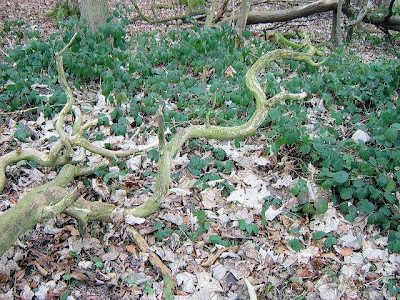
This is where many of the weird-shaped branches and weird-shaped trees come from.

Aren't the colours wonderful?
Near here we meet a track which points down to the car-park which is why there are more humans than in the earlier bit.
Continue for some distance past a memorial stone to Hazel ffennell, who sadly died young and whose father gifted the woods to the university in 1943, and then turn down another track, where you come across a rather fanciful-looking building:

This is known as the chalet: when I lived in the woods, the Warden lived here; now Wytham Woods has a Conservator (probably a more accurate title and probably posher) but I don't think he lives here - I could be wrong!
From here we take a real road downhill (we've walked a long way already, need to get back and therefore must leave Wytham Great Woods for another day) to where there was once a working sawmill, and follow the path along a wondrously idyllic-looking green field full of sheep with Wythan Abbey in the distance:


And from there, back along the Gallop through swarms of runners who have a habit of appearing suddenly - the really fit ones give you a breezy hullo as they pass - to the top of the land.
Looking over a fence, we see the path through Rivendell (see yesterday's photograph) so sunshiny and lush with mosses and spngy turf we can't resist, so on we walk along it, not minding that it's taking us in another direction from where we want to be: I know these woods and know we'll get to a turning that leads onto the bottom track and this area has always been magical for me.
And then onto the track: when I lived here there used to be a house called Marley Lodge at this point, but now it's gone and there's no trace: it was fairly primitive, had no foundations, and was demolished when the last occupants left.
More interesting bits of tree along the bottom track which would be even more idyllic if you couldn't hear the A34 which runs close by:

And home to warmth and food!