Showing posts with label friends and family. Show all posts

Monday, 10 February 2014

Connection at Forge Mill Needle Museum

Last year I was fortunate enough to be selected as a guest artist for Cwilt Cymru, a group whose work I had admired since seeing it in the Spirit of the Celts exhibition.  The theme of the current exhibit is Connection, and I have chosen the connection with my mother as the focus of what I produced.  Since my mother's side of the family is entirely Welsh it seemed appropriate and I had been planning a series of pieces on my relationship with my mother for some time.
 
The first piece was an enjoyable and fairly straightforward quilt to make, called My Mother Made Spitfires, focussing on my mother's experience as a war worker at Vickers Armstrong's Castle Bromwich factory near Birmingham, where she was involved in making parts for Spitfires.


The hours were long, the factory a target for bombing, and the work heavy (the machinery she operated, a capstan lathe, was later deemed unsuitable for women to operate).  Even so, her wartime experiences, as she described them to me, were full of fun, films, fashions and dancing.  She had more freedom and more money than she had had before and like many others at the time had a determination to enjoy life to the full (the fact that life was uncertain at the time probably had something to do with this).  It was during these years that she met my father, a GI she married shortly before his return to the US in 1946.  The quilt tries to draw together the different aspects of her life at the time.
 
The poster at top left is used with permission of the Imperial War Museum.  Other images are adapted from contemporary sources, and the photograph near the bottom right is a photograph of my mother, printed onto Extravorganza and overlaid onto hand-dyed fabric.
 
The poster suggested the colour-scheme for the quilt: the base fabrics are cottons hand-dyed in various combinations of orange and purple.  Some of these have been digitally printed with images from the time and my own words describing my mother's experiences.  Overlays of digitally-pinted Extravorganza have formed a basis for applique, and the whole piece has been free-machine quilted.


The second quilt Turning Ugly was a different matter.  Originally I had planned to take a different area of my mother's life as the focus and to produce something relatively "safe", but as time went on my thoughts constantly got drawn to the years after the war, in particular a two-year period from November 1949 which were the worst two years of mine and my mother's life.

I was conceived shortly before my father's return to the US.  In the early days of her pregnancy, with my grandmother ill, and possibly getting cold feet about the whole experience, my mother did not take up any of the three passages allocated to her as a war-bride.  In 1949 my father divorced her.  She also lost her looks when she suffered a form of facial paralysis called Bell's Palsy which she never completely recovered from.  In November 1949 she married a recently-widowed father of two small daughters and we went to live with them in a village between Chepstow and Tintern in the Wye Valley, a beautiful part of the country made hideous for us because of the violence and abuse we both suffered.


The idea was to produce a quilt that had a sort of "double-take" effect: that looked beautiful on the surface but became other than that when you looked up close.  Originally the words that described the experiences were going to be obscured (as in the piece at top left) but as the quilt was being made, things changed.  The pieces of the story first became blurred but readable if you tried hard (written in inktense pencil overlaid with organza) but in the end they were written in stitch, on the surface of the quilt.  And one set of words - describing in outline an experience which I kept hidden even from myself, but which has been like a sort of invisible ghost haunting me all my life - emerged as I was writing it.  So that the quilt became in itself what it was never intended to be - a sort of therapy.


My neighbour pointed out that I had probably saved myself quite a lot of money in therapy costs - and I had a quilt at the end of  it.  It's been a very painful and difficult process but I now feel lighter and happier than I've felt in my life.  One thing that bewildered me - the last stage was quilting the larger squares: and it came out - unplanned - like this:


 With very free, joyful lines of quilting redolent of growth and natural forms - exactly the way I felt as a result of the process of making the quilt.
 
The exhibition - which contains beautiful pieces by the six permanent members of the group as well as the other three guest artists - opens at Forge Mill, Redditch tomorrow (11th Feb).


Sunday, 15 September 2013

R.I.P Django 1999-2013


The sad news is that my lovely cat Django died suddenly on Wednesday night.  It was very sudden and very unexpected.  Despite his age it looked to everybody as if he would be going on enjoying life for some time yet, but he unexpectedly collapsed and died, all within the space of a few minutes, almost certainly of a heart attack.  The good thing is that he was able to enjoy life right up until the end and any suffering seems to have been extremely short-lived.

Django had been taken in to my vet's as a twelve-week-old feral kitten for adoption.  He had obviously done well as a feral kitten by charming everyone in the neighbourhood.  When I arrived at the vet's to pick him up the entire staff were taking it in turns to give him a cuddle before he left: he was purring loudly and obviously enjoying every bit of attention.  When he arrived at his new home it didn't take long for him to be accepted.  Though the oldest cat, Hoagy, took his time getting to know him, Bixy took to him immediately, and became a kind of surrogate mother.

Django was a fine example of how to get the best out of life.  As a kitten he was extremely naughty, leading the older cats on wild disruptive rampages round the house, creating chaos in his wake.  He was known round the neighbourhood as "the cheeky one" of my three cats.  The only trace of his feral origins was his exceptional scavenging abilities (we once lost a pack of peppered beef and later discovered the opened empty pack and the peppered rind under the sofa and on several occasions found sandwiches and wrappers minus fillings on the kichen floor.

 
Django loved fabrics (especially silks) and was an ever-present studio cat.  On one occasion he experimented with dyes and I found him sauntering proudly down our back alley with bright blue feet.


In 1995 Django had a serious accident, getting knocked down by a car and smashing his pelvis to pieces.  He made it back to the back door by dragging himself on his front claws, which must have been agonising.  Luckily there were no injuries to internal organs but he did need extensive surgery (and a fair selection of nuts and bolts) to put him back together again.  The injuries were so serious it took a couple of months before he was walking again.  At the time I wondered whether I would ever see him walking along the fence again.  The neighbours bet it would take two weeks: in fact he was back there within four days.
 
 
Django suffered from arthritis in later years but despite having to slow down sometimes (though he still played tag with Pepper from time to time and took stairs two at a time and took strolls round the neighbourhood, including on the last day of his life) he remained a lively, bright and extremely affectionate through it all.
 
He was a very special cat and I shall miss him.


Tuesday, 18 October 2011

June-September Journal Quilts

For this series of CQ Journal Quilts I have chosen to explore family history, specifically four generations of women in my family at similar points in my life.  These pieces all use text - a specific requirement for JQs in these months.

The first piece, 1968, relates to myself - yes folks the picture below really is me, taken from my passport photo, posterised, solarised and blue-printed in Paint Shop Pro, then printed onto Extravorganza, cut out and stitched down with a simple running stitch, which has also been used to emphasise some of the features.  It is appliqued to a piece of tie-dyed silk taffeta; the whole thing was then machine-quilted, very simply, using the same thread as for the applique, then bound with tie-dyed cotton.

The words round the edge were suggested by an idea from fellow CQ member Margaret Cooter, who created a piece of artwork using the last three words of popular phrases.  In my case I have used the last three words of favourite sixties quotations, plus one quotation from something written later about the sixties.

In 1968, I was a student at London University.  It was a heady time, with a rather strange feeling of a worldwide student community (I suspect for those of my contemporaries have to devote their energies to earning a living things might have felt different) and a real belief that we could change the world.  It was also a huge amount of fun, and a great time to be a student in the swinging sixties. 


The second piece centres on a picture of my mother in 1944.  She was then doing war-work in the Vickers Armstrong factory at Castle Bromwich in Birmingham, making Spitfires (she told my brother about the Spitfires, me about the partying that went on in off-duty hours); to hear her talk it sounded like a bundle of laughs; it was only later that I found out about the long hours operating a capstan lathe and the fact that the factory was the target of bombs (one bombing raid had taken out one of the main sections).  This piece again uses a photograph (printed "straight" this time) on Extravorganza, layered onto pale fabric.  The background is a contemporary fabric of the sort used to make overalls and aprons; another contemporary fabric contains the text that describes her life at the time.  The poster is used with permission of the Imperial War Museum.  The whole thing is quilted very simply, with the addition of the outline of a Spitfire.


In 1926, the year of the General Strike, my grandmother, who is the subject of the August JQ, was 23.  She was a miner's daughter, married to a policeman, though there doesn't seem to have been any sense of divided loyalties; though having to police pickets and demonstrations publicly, in private my grandfather sympathised strongly with the miners' cause; he also helped support her sister's family through the hard times of the twenties and thirties.

Unfortunately, I have no early photograph of my grandmother, though I do remember her as very young-looking well into her fifties.  The drawing here is a combination of later photographs and my own memories - though not the best drawing I have ever done it did succeed in capturing something of the look she had.  The other pictures are all taken from contemporary sources, and again there are some details in print about her life at the time.


The final piece centres on my great-grandmother.  My research into family history began with her, and I have included the family record from the 1901 census as well as a tinted photograph from a couple of years earlier, at around the time of her wedding (again printed onto Extravorganza)  The census entry means the piece goes back a further generation, including my great-great-grandmother.  Both were quilters, and they quilted professionally.  My great-grandmother died young, in the flu epidemic of 1919, but her mother went on to quilt for the London market in the 1920s, in common with many other women from her home town of Maesteg in South Wales.

Both census entry and text are printed onto commercially-treated cotton, with hand-painted silk chiffon layered over to give an antique feel.  The whole piece is hand-quilted, including a characteristic Welsh spiral pattern (which unfortunately doesn't show too clearly at this scale.


One annoying feature.  The commercial fabric I bought came in sheets, and unfotunately none of the sheets in the pack were straight, as a result of which it distorted when being taken off the backing paper, and no amount of gentle tugging could make it straight again - unfortunately I had not more left and it was getting just about to the deadline by then so I had to go with what I'd got.  But I shall be exploring similar themes again - and next time I'll get it right, I promise!


Tuesday, 22 June 2010

bad blogger posts again - art and function, family and influences

First apologies for not posting for such a long time - I've been stitching for Festival of Quilts, decluttering the house, trying to tame the garden and - as a result of the decluttering and the tenth anniversary of my husband's death - reliving bits of the past both bad and good...

So it's been time for reviewing what's happened so far - not a bad thing to do once in a while.  Coincidentally, one of the recent discussions in the Contemporary Quilt Yahoo group had me putting together a lot of the pieces this morning.  The discussion was sparked by a comment from Helen Conway, a member of the Twelve by Twelve group, during an interview about their work, in which she talks about having to overcome the feeling that creating something not strictly functional was somehow "self-indulgent and wasteful."  This led to a lively discussion, which I am responding to here, about how and whether people feel guilt about what they do and the time and money spent on it, and how they overcome that guilt.

My mother grew up in a Welsh mining village, Maesteg, where there was a strong Protestant tradition, with astrong streak of puritanism woven into it.  Everone in the family was expected to subscribe to the idea that you were supposed to work hard for what you got.  And when times were hard the women made sure they looked after the men's and children's needs before their own, often going without themselves.  However, bound up with this was the idea that when work was finished you were allowed to enjoy yourself - hence the rugger, boxing, singing, picnics, walks in the country, decorative crafts, reading for pleasure and so on that also made up their lives.  As far as I know no-one felt guilty about enjoying what little leisure time they had.

My mother photographed here shortly before she died


continued this tradition, but with some variations.  When not at work (she worked part-time) she and my grandmother, who lived with us, had the housework done by lunchtime.  Depending on the wather, the afternoons (which I remember as wonerful times) were spent going for walks, reading, gardening or doing other enjoyable things (though I did not inherit the green fingers); and I grew up believing that this time was something you were entitled to.  I am heartily grateful for that: such a belief has stood me in good stead. 

My mother also believed, along with my grandmother, in beautifying the house.  (I just typed beatifying which would work just as well).  Every so often we would arrive home from school to discover total chaos for a couple of days as one or other os the rooms was redecorated.  Usually to very good effect - much of my colour sense I learnt from my mother.  And the same attitude went for clothes: we couldn't afford much and day-to-day clothes were often hand-me-downs from better-off members of the family, but best clothes were always the best that could be afforded (though a good suit - usually called a "costume" in those days - would have to last a long time) and looking positively stunning in them was a definite plus and definitely not something to feel guilty about (I could never understand the streak of puritanism that dictated that everything had to be ugly).

As far as stitching and artmaking goes I was lucky enough to learn that that was guilt-free too.  My mother knitted and embroidered - often what she made could put to practical use but it was far more than that - she knitted complicated fairisles and lacy things that wen well beyond practical, and as the embroidered items were never actually used they cannot be said to have been purely functional by any stretch of the imagination.
And she also encouraged me to paint (largely I think because it gave her a chance to paint herself) and drew the most amazing cartoon characters.  As I grew older she was proud of my ability to use a brush and a needle - though when it came to career choices the protestant ethic won out and I never got to go to art school: university plus teaching gave far better options for making a living.

And for myself what impact has it had on me?  Well, as a student I had no remorse about wasting anything except food (and the idea it was sinful to waste unless it could be avoided has stuck with me - from time to time I have to clear out the unidentifiable objects from my freezer - it's OK to waste them if you can't remember what they were or when).  I wasted time and money with enormous enthusiasm - though I did have one term where I had to dig myself out of an enormous hole, and managed to do so.  Once I started work and got married though I suddenly reverted to type: my husband at one point had to persuade me that I should spend money on clothes for myself, and it took a few more years before I could persuade myself that I should spend money on other things I wanted...

My husband was an enormous influence on me:  he never considered time or money creating stuff as in any way wasteful.  To him it was a positive.  Here we are in our youth, together but in separate photographs (note the matching M&S jumpers - sweet eh?):


Perhaps the fact that he was a painter (oil and acrylics rather than gloss and emulsion) had something to do with it.  Also he did regard what he did that he wasn't being paid for as more important than his paid work (which consisted of work supplied by an agency which consisted of things like paintings of racehorse, portraits from photographs and so on - including some rather unusual ones like the thirteen head and shoulders drawings of Edward Heath which is probably now mouldering in a basement somewhere in Conservative Party Central Office - difficult to draw without caricaturing, apparently!).  When I took up quilting he understood and encouraged - visiting exhibitions, offering constructive criticism and sharing my enthusiasm for interesting fabrics.  On the day when he said he could no longer teach me anything about colour I really felt I'd arrived (admittedly up till then his colour advice had usually been "needs some gold" but it is amazing how much a touch of gold, yellow, cream or mustard can do for a quilt or a painting)

But probably the thing that did most to stop me feeling guilty about spending so much on quilting was my health.  I started quilting at a time when I was spending hours and hours on my job (teaching in an inner-city school meant I spent hours on preparation and planning - not being a "tough guy" I had to keep the kids entertained and happy as well as educating them) as well as on union and political activities in my spare time (the protestant work ethic in operation with a vengeance).  I decided to timetable in an evening class to keep myself sane - two hours a week that would be sacrosanct and just for me; the hand-stitching also kept me alert and productive during all the long boring meetings I had to attend.  In a few months I had made my first quilt:


Because I still hung onto the belief that to be any good it had to involve a lot of work I ended up doing an elaborate border pattern (not realising that the unquilted areas would gather up and stick out like  a sore thumb) and this is where the Protestant ethic transformed into a new shape.

But first, the health issue - quilting came in time to preserve my sanity but not my physical health.  I ended up having to retire from teaching with what was then called ME and is now more often called CFS; even the simplest things left me ill and exhausted, and having pinned so much of my sense of worth on doing things, it was terrible no longer being able to do them.  Being unable to knit (my hand-muscles tired too quickly) I turned to hand-stitching, and unable to do that for long I spent longer thinking about and designing what I did.  Being lucky enough to win third prize in the Harrogate show (this is way back in the nineties) for a cot quilt gave me a sense of achievement once again.  As I got better I was able to use the sewing-machine again, and attend a City and Guilds course.  And all this was guilt-free because I felt so good about actually being able to do it, and yes I really got a boost when, a couple of years later I completed my first quilt out of hand-dyed fabrics, to my own design:


This quilt, Caging the Moment, completed in 1996 for an exhibition at Lotherton Hall in Leeds, also won the Quilters Guild cup for use of colour at the Great British Quilt Festival in Harrogate as well as rosettes for bed quilt and use of colour at Quilts UK in 1997-8.

However quilting had still not become guilt-free.  I was now burdened with the need to live up to what I had achieved and felt that I had failed dismally every time I made something which wasn't wonderful (which, of course, was most of the time).  I had merely ditched one set of "ougt-tos" for another set: I ought to spend ages doing it, conforming to the rules of the quilt police, making it as good as possible (and preferably winning awards whixh has only happened one more, in 1998) in order to be a worthwhile person

Between my husband's death ten years ago, which I partially blamed myself for (I should have been able to affect his lifestyle choices and his inability to cope with his own inner demons I felt at the time - as we all do when someone dies) and four years ago I made nothing, the longest I have gone without creating anything in my life.  Recently I have been thinking about that period, feeling I had achieved nothing of note since his death.  The reality of course is different - a close friend presented me with a long list including things like digging myself out of near financial ruin, restoring a house that had begun to fall down around my ears, getting through cancer... 

But I suppose that the thing that I have really learnt in the last few years, since I started stitching and drawing/painting again is that failure has an enormous amount to contribute to success.  And though it sounds cliched, having cancer reminded me I only had one life and I had better make the best of it and avoid as far as possible wasting time in guilt.  Though my work is moving towards becoming more simple, with the design process being more often than not a process of paring down rather than cluttering up, I am still battling with a tendency to want to clutter it up with more than it needs, in attempt to justify its existence by ensuring the production stage is as much hard work as possible.  So I've still got some distance to go.

Bixy the white cat, who is still on a fairly unsuccessful diet, has just come and spoken sharply to me because his food bowl is empty.  Although, unless I have hurt someone or let them down, humans have lost much of their capacity for making me feel guilty, cats are a different matter.  So that's it for now.

Sunday, 17 January 2010

the quilts I made for Christmas (well almost!)

For Christmas last year I made a quilt for my brother and sister-in-law.  This was much admired, has been used and washed and still looks pretty good (better, in fact, as I didn't pre-shrink the cotton wadding and it now has a lovely texture) even if I do say so myself.  My two twenty-something nephews loved it:: the elder,Carl, and his girlfriend Elise wanted to commission me to make one for them too; the younger, Gareth, said it was the "dog's b*******s" which is possibly the most unusual compliment on a quilt I've had.  Faced with such enthusiasm, how could I resist?  I'd always iutended to make them quilts anyway - just waiting for the right time.

The quilts didn't quite make it in time for Christmas: Gareth's was part quilted and bound so I was at least able to present him with it on Christmas morning, I reminded him of his previous compliment and said my provisional name was "The D's Bs" (I move in much politer circles than he does); his reply - "no, this one's The Mutts N**ts" and so that is what it will be called:


This is just part of the quilt: the detail tends to get lost in the larger photograph: individual blocks are made up of four chevron log cabins with different sized centres with the strips deliberately misaligned:

The fabrics come from across the globe, with fabrics from Zimbabwe (courtesy of Magie Relph).Gareth has a liking for interesting textiles so I thought these would add to his collection.  This quilt was real fun to make and went together like a dream: I have added more quilting but there is still a  little more to do.


Carl and Elise's quilt was also fun to make, and I was able to use a lot of the Kaffe Fassett fabrics I love for this one.  Originally I had planned to use the fabrics I bought from Aussie Dreams designed by Australian aboriginal designers (Elise is Australian), but I couldn't get theme to fit into the agreed colour scheme (sunset colours) so the next gift might have to be a wallhanging!


Of course Django had to get in on the act - he can't resist a camera - or a quilt!  The individual blocks are four-patch stars which make up a secondary design when they are put together.


The current title for the quilt is Southern Star (given the antipodean connection).  They haven't seen it yet - they spent Christmas in Australia at Elise's family home in the Blue Mountains where I trust Carl managed to cope with his spider phobia and Elise's nephews (and I'm still waiting for news of how they reacted to being given England cricket shirts for Christmas presents!).  They also spent last week in tropical Thailand and missed all that lovely snow - it's a hard life but someone has to do it.

If you've got round to reading this, Carl and Elise, welcome home and hope you like the quilt!

Friday, 11 September 2009

Journal Quilts May - August

This series of four continues the steps theme by celebrating journeys. The first, a walk through Bolton Abbey Woods in May. There's a shelter on a path that takes you on a steep walk up through the woods and while you eat your lunch and draw your trees you look down on the view on which the first journal quilt is based.


I've called it May with its Light Behaving from one of my favourite W.H.Auden poems. It's made by first stitching the outline shape of the river onto the wadding, then cutting it back. I did this in hand-dyed viscose satin, two layers, one river-coloured, one green; flipped up the green to cut away the grey (avoids having two layers of thick fabric), then used reverse applique scissors (also called lace scissors) and carefully cut away the green where the river should be. Then laid pale viscose organza over the river, free-motioned outlines of the shapes and cut this back, and did the same with green hand-dyed silk-metallic organza over the trees. Finally had lots of fun with free-machine quilting, stitching very closely over the exposed edges to secure them (usually I use granite stitch (small overlapping circles) to do this, but there are other options). And isntead of binding I've couched down some metallic/viscose hand-dyed chainette.

The second is inspired by a view I had to reconstruct from memory. Driving to Contemporary Quilt Summer School I decided to take the scenic route through the Forest of Bowland; after taking a wrong turning it became even more scenic (I knew I was in the right direction so I wasn't actually lost, though there was a hairy moment when a signpost had got turned round).
I rounded a corner and suddenly came across this view - nowhere to park up and not really safe to stop on narrow winding roads so I had to simply drive slowly and commit it to memory. It was chiefly the colours, the golden field full of buttercups, the green hedges, the blue hills beyond. The whole area is the essence of The Shire in The Lord of the Rings. Tolkein knew the area well and used local place-names from this area, so I've called it Not All Who Wander Are Lost.

Hand-dyed silk habotai and taffeta, overlaid with gold chiffon (field) and blue (hills) organza, then free-machine stitched. For the binding I cut the rolled hem off the gold chiffon scarf I'd used, rolled in the raw edge and couched it down.
I had planned to combine a visit to my brother with Festival of Quilts, but in the end FOQ won out as I thought if I tried to do both I'd miss out be not being able to give either my full attention. So after making the decision in July I used a remembered walk from Christmas and imagined what the Dead Tree Walking would have looked like with late summer woodland colours behind.

More silk hand-dyed habotai with hand-dyed silk charmeuse fused on, and the whole thing FMQd.
Another walk in Strid Woods was the inspiration for my August journal quilt. A favourite place. The colours came from a photograph my late husband had taken of the Strid many moons ago at this time of year. This is the one I had most fun making. It's built up in layers. Silk charmeuse, viscose satin, silk habotai as a base layer, then built up in snippets and layers of silk organza, with some layers being partially cut back, with a layer of undyed white organza for the frothing water: a combination of onlay, reverse and shadow applique. The final layer was the stitching, added a bit at a time (I have a tendency to overdo it). I loved doing this, and though I have reservations about some aspects of it (this is normal for us all, right?) I really like the finished piece. Though I didn't enjoy binding it in velvet, it did work better than any other fabric for binding.

This one could end up being the first in a series. Now on to September and beyond...


Monday, 31 August 2009

Back from Festival of Quilts


Back home from Festival of Quilts - very enjoyable but ill afterwards - I tend to forget that the CFS (Chronic Fatigue Syndrome, what used to be called ME) I once suffered very badly from never actually goes away completely and got hit bad this time. Very much worth it though. Not only some amazing competition quilts and other pieces but also a wealth of exhibitions, and a chance to meet up with friends old new and virtual! Finally got to meet Maggie(http://stitchingwithschnauzerandsiamese.blogspot.com/), together with Kath Danswan (http://stitchingswan.blogspot.com/), and Hippopip (http://hippopip.blogspot.com/), plus renewing acquaintance with fellow Contemporary Quilt members Margaret (http://margaret-cooter.blogspot.com/), Mai-Britt (http://www.linen-and-silk.com/) who won the miniature section with a beautiful art-quilt, and a judges choice with an equally gorgeous larger quilt, and - briefly - Marion (http://artmixter.blogspot.com/) and other margaret (http://magsramsay.blogspot.com/) whose quilt in the Guilds Challenge section should have won a prize but didn't. Not forgetting of course Julie (http://mixed-media-jem.blogspot.com/) who I spent a really good evening with - part of it hilariously driving round Birmingham getting lost!
I did spend some of the time on various stands. For three of them it meant a chance to sit down and talk to people. For the fourth, not a chance to sit down or relax - the tombola was amazingly busy (who knew quilters had such a worrying gambling addiction?) and hugely successful, taking £9,800 or so; enormous fun to take part in as well.

Apart from that I spent some time on the Contemporary Quilt stand - very relaxing as I was surrounded by people who knew a lot more about CQ than I did ; SAQA - Studio Arts Quilt Association - http://www.saqa.com/ -(this being the second SAQA exhibition I've stewarded I felt like an old hand and didn't have to make too much of an effort to "sell" the organisation seeing as the exhibition was superb - a number of visitors thought it was the best in the show); and last but not least, SDA (the Surface Design Association) - http://www.surfacedesign.org/
where we managed to up European and UK membership significantly - thanks to the organisation and selling skills of Lindsey Lang, the UK rep.
People have been asking to see my entry so here goes. First a bit of a grumble. FOQ organisers had asked for detailed hanging instructions so I obliged by giving details of the size and height of stand needed (and sent in a life-sized model to boot) only to have these details ignored so that my effort suffered by being displayed in a way I had specifically asked for it not to be at coffee-table height and with very poor lighting. I'm sure it made no difference to the overall result - the winners in this section were amazing - I'd just have liked - after all that work - for it to be displayed in such a way that people could actually have seen it as it should look. So here's a ccouple of photos (above - seeing as blogger won't let me drag them to anywhere else on the page) taken at home: I was hoping to get a better one at the show but the poor lighting prevented that.

Thursday, 23 July 2009

Harvey and John update

By the time the programme ended I was already getting asked for information so here goes:
website is: http://www.freewebs.com/vanvon
phone: 01859 530 485
address: 1 Lickisto, Isle of Harris HS3 3EL

I was prepared to be impressed but found it even more impressive than I expected it to be - and love the idea of secluded campsite pitches coupled with good-quality facilities. They deserve to be successful and I'm sure they will be.

Tuesday, 21 July 2009

Harvey and John on t'telly

From here...


To here...

Harvey and John, my friends who left Leeds to move to the Isle of Harris for a different kind of life are on television tomorrow (Wednesday) night - UK television programme Build a New Life in the Country on Channel 5 at 8 p.m., repeated on Thursday at 8 p.m. on Fiver. I've just watched the programme on http://demand.five.tv/Series.aspx?seriesBaseName=BuildANewLifeInTheCountry
and even without knowing Harvey and John I think I would have found it riveting to watch them working ro restore the buildings and prepare to open a campsite business on thirteen acres of land through sheer determination and on a tiny budget all done with their usual wit and good humour. For those of you not in the UK you can see the programme on the link above.

Monday, 5 January 2009

There and Back Again


Many thanks for the complimentary comments on the Wytham Woods photographs: it is very photogenic woodland so it wasn't difficult to get interesting ones.

For the third and last visit to Wytham Woods I am going to take you with me on one of my walks. First is a mile and a quarter stretch of uphill which will at least warm you up in this freezing weather. The track on either side is bordered by a band of trees on either side with farmland beyond, reaching a kissing gate with - on this particular morning - a rather hazy view of the "dreaming spires" of Oxford.

Here a pause to catch our breath and answer Julie's question. Tolkien would have known Wytham Woods, though I have been told that the Old Forest is in fact based on somewhere else, so it's difficult to know how much he was influenced by them. I first read The Lord of the Rings after we moved there and found the woodland described in the book very familiar indeed!


Through the kissing-gate at the top of the lane, bear left and you enter the are known variously as (to me) the top road, (to locals) the Gallop and (on the Wytham Woods official map) the Singing Way. Here we find a startling sight - felled logs. Timber is cut from these trees from time to time and moved to the roadside by horse-power, one horse at a time to minimise damage to the forest floor.


We can pause here for a rest, and look at the amazing shapes of the stacked logs ...

and the strange shapes and colours of the fungi on them:

Now the walk becomes a nice level trudge along a good path (soft underfoot providing you walk on the middle bit) to the sound of bridsong. There's all sorts of wildlife all around us but the things that can move are hiding (and I'm not sure I really want to investigate what's under those logs)


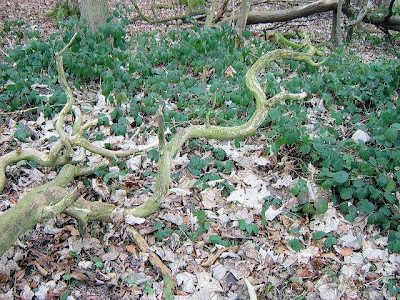
This is where many of the weird-shaped branches and weird-shaped trees come from.

Aren't the colours wonderful?
Near here we meet a track which points down to the car-park which is why there are more humans than in the earlier bit.
Continue for some distance past a memorial stone to Hazel ffennell, who sadly died young and whose father gifted the woods to the university in 1943, and then turn down another track, where you come across a rather fanciful-looking building:

This is known as the chalet: when I lived in the woods, the Warden lived here; now Wytham Woods has a Conservator (probably a more accurate title and probably posher) but I don't think he lives here - I could be wrong!
From here we take a real road downhill (we've walked a long way already, need to get back and therefore must leave Wytham Great Woods for another day) to where there was once a working sawmill, and follow the path along a wondrously idyllic-looking green field full of sheep with Wythan Abbey in the distance:


And from there, back along the Gallop through swarms of runners who have a habit of appearing suddenly - the really fit ones give you a breezy hullo as they pass - to the top of the land.
Looking over a fence, we see the path through Rivendell (see yesterday's photograph) so sunshiny and lush with mosses and spngy turf we can't resist, so on we walk along it, not minding that it's taking us in another direction from where we want to be: I know these woods and know we'll get to a turning that leads onto the bottom track and this area has always been magical for me.
And then onto the track: when I lived here there used to be a house called Marley Lodge at this point, but now it's gone and there's no trace: it was fairly primitive, had no foundations, and was demolished when the last occupants left.
More interesting bits of tree along the bottom track which would be even more idyllic if you couldn't hear the A34 which runs close by:

And home to warmth and food!

Saturday, 3 January 2009

Meetings with Interesting Trees

My brother lives at the edge of Wytham Woods, owned by Oxford University and used for research projects. Unlike most managed woodland it is for the most part left to develop naturally: many areas qualify as "ancient woodland" where the undergrowth hasn't been cleared. Mostly oak hazel and beech, with additions like the ivy which wraps itself round the tree below:

Trees here are allowed to split, droop, fall apart, decay and above all grow unrestricted:


I spent a number of happy hours this holiday re-exploring the woods where I grew up (and discovering that I was fit enough to walk for miles and miles without getting tired, which was also a bonus!)