Sunday, 9 November 2008

SAQA Auction


The SAQA Auction starts tomorrow. In case you don't know, SAQA stands for Studio Art Quilts Associates, and members have contributed twelve-inch square quiltlets which are to be auctioned in three lots. My contribution, Effervescent Evanescent is above - inspired by the bubbles in my bathwater, techniques include cut-back applique using layered scrim and free-machine stitching.

There are quilts by some of the world's leading artists up for grabs, so why not get yourself over to the website http://www.saqa.com/ and have a look!


Thursday, 6 November 2008

Congratulations America


I suppose part of the euphoria amongst democrat voters in the US must be like what many of us in the UK felt when the Tory party was finally routed and Blair came to power, a night when cheers could be heard echoing down our street and next day everyone was smiling at each other - not that I feel Tony Blair stood the test of time very well but it felt really good to start with.
But aside from being great news for America politically, historically it has been an astounding victory. I remember, when I was a student seeing news footage of the Civil Rights movement, being horrified at the killing of Martin Luther King. And now, in what is, historically speaking, a relatively short period of time, America has elected an African-American president. As one African-American woman said on Monday, "Now when we tell our children they can achieve great things they can believe us."
And it's also a reminder for us in the UK that despite in theory outlawing discrimination we still have some way to go.

Thursday, 23 October 2008

Castleford Weir: Fast Friday Fabric Challenge

I've been a member of the Fast Friday Group for a year now, though many of my pieces I have to admit are awaiting completion. However I have determined to complete this year's challenges.
For this year we have decided to work in a series, with emphasis on colour and composition (it's a great group for learning and artistic development). I have decided to base my series round Castleford Weir in West Yorkshire, including the new award-winning footbridge over the weir photographed in a recent post, and decided on the mill-race as the topic for the first piece:

This month's challenge had also to be composed of basically complementary colours, and had to have a strong vertical, horisontal or diagonal composition.

I'm not sure whether this is creative cheating or not but I wanted a series of muted greyed colours for the stone and water so I did several blue-orange dye-runs, including (at the top of the photograph) runs of the basic colours mixed with black. The dyes are Procion MX Blue 2G (sometimes sold as cobalt or cobalt navy) and Bright (Pillar-Box) Red G plus Gold 3R for the orange.
I simplified the photograph, flattening the perspective, and exaggerating the height. The water-shapes have been simplified considerably too, to give a poster-like effect. In fact the design is what took longest (I have to work hard to get to be this simple!). Fabric pieces have been fused onto a dark blue background which has been allowed to show through in places because I wanted it not to look too smooth.


The piece still needs stitching, which I intend to do today - some of the features such as the mill-wheel will also be added in stitch. Must admit I feel quite good at the moment about the overall result.

Next challenge begins tomorrow and I'm really looking forward to it.

Thursday, 16 October 2008

Back to School

After visiting the Festival of Quilts I decided it was time to overcome my fear of the D word (drawing in case you haven't guessed) so I signed up for not one but two beginners'/returners' courses at Leeds College of Art and Design: they're also designed for people wanting to put together a portfolio of work in order to apply for mainstream art courses.

The two classes complement each other. One is based not at the Art College itself but at the Leeds Museum Service centre where stuff not on display in the city's museums is stored, catalogued and so on - everything from stuffed zebras to 1960s juke-boxes. This caourse is drawing-based and already I'm learning how to look at things in order to produce a (relatively at this stage) accurate drawing, plus looking at other options than academic naturalistic drawings.
The other course is so far more wide-ranging, including different media - there will even be a chance to try some sculpture later.
The great thing is I can feel my confidence developing already. I'm beginning to look at things differently and am making full use of the various sketchbooks I have. Also two great groups of people - on the first one a small group of all women enabling me to attempt things in a friendly and supportive atmosphere; on the second a wide mix of both men and women including a large number of young people - creating quite a buzz.
Hopefully it should all soon begin to trickle down into my fabric work!

The photographs in this post are of items from the museum collection we used last week for still life - using simple shapes to learn the basic principles of perspective. Hopefully, when I get a bit more confidence I'll post some the things I've done.

Thursday, 25 September 2008

Ah, Sunflower, weary of time


A tenuous link to the topic for the day, but it makes for a nice photo.

Topic for the day, in case you haven't guessed, is time. How we use it, waste it, get resentful of it and what to do about it. Inspired by several posts recently on my good friend Marie's blog http://zquilts.blogspot.com/ .
For many of us, the problem is not having enough of it. For many years I was a full-time teacher which, with preparation, marking, training out of school hours and so on meant an average of between 50 and 65 hours a week in term-time; to this I somehow added being a local NUT (teachers' union) officer plus local labour party officer and school governor. On Monday nights I had two hours I carved out for myself which I prioritised as me time when I went to a patchwork and quilting class.
The inevitable happened - with a little help from the education authority (schools in Leeds were reorganised) and the government (the whole education system in England and Wales underwent radical changes - to my mind not for the better) and the fact that the school I worked in was part building site. I achieved burnout. To be more specific, I ended up, after a period of trying to work through illness, with Chronic Fatigue Syndrome (CFS - what used to be called ME) and had to retire from teaching (and everything else) and was unable to work at all for five years.
However, having CFS (which you never completely get rid of - I still suffer the symptoms at times, though in a very minor way) taught me a lot about managing time and keeping up morale.
There are no quick fixes for this condition - you have to learn to live with it; if you manage it carefully you improve, but there are no guarantees: I was one of the lucky ones. Some things I had to give up - reading for the first two years (I could not maintain concentration for long enough); machine stitching (couldn't sit at the machine for long); couldn't even watch television for long (ended up seeing double when I exhausted the eye muscles so the two sets couldn't work in synch properly).
What I learnt to do was this: to do things but in short stints (sometimes as little as ten minutes) with rests in between. I learnt to see rest as a positive thing and not feel guilty about appearing to be lazy. I learnt that I was more likely to get the bouts of depression associated with CFS if the things I did manage to do included not only things I ought to do but also things I wanted to do. I learnt to compromise. As I improved I learnt that it was possible to do some of the big things I wanted to by resting beforehand, taking it as easily as I could at the time, and being prepared to suffer afterwards (after my first quilt show at this time I was ill for a week and could only get upstairs on all fours). I also learnt to adapt: you can iron sitting down; it's an interesting exercise choosing domestic appliances using weight as your foremost criterion - I managed to buy the worst vacuum cleaner in the world that way!
One of the things I found most useful is an exercise I was taught in a time management class, basically as a prioritisation exercise for busy managers.
(i) You begin by defining your discretionary time - that is the time that isn't timetabled or given to routine things that have to be done every day - i.e. time where you get some choice about what you do.
(ii) Then each day you begin by making two lists, one of ten things you want to do and one of ten things you ought to do. It's not unusual for some things to appear in both lists. Having to find ten things you want to do makes you dig deeper into the possibilities of just how you could use your time if you weren't forever trying to catch up on the "oughts". One suggestion - make the items relatively small - preferably no more than an hour (it can be considerably less!), two at the outside - break down larger things into smaller stages.
(iii) Next stage is to prioritise. Look at your lists and pick out the one thing you most want to do; one thing you ought to do which is most urgent. Start a new list and write these down as items 1 and 2, then bracket them together.
(iv) Leave a space on your list then write down the numbers 3 to 6, one on each line. Choose the next two things you'd most like to do and the two things you most ought to do and write these in: again bracket them together.
(v) Repeat the process for items 7 to 10.
Do not agonise over this process - it should normally take less than ten minutes.
What you now have is a working list for the day. You work your way down the list. The only thing you HAVE to do is complete the first two priority items. If you manage to get to six you are doing well. Few people manage all ten. Any things you haven't done can go onto next day's list - or you may find they're not as important as you thought and they can disappear altogether.
I found this useful when I had little time at my disposal. I find it even more useful now I am retired and have oodles of time. It means I can give my days a structure. It means I am finally getting to grip with actually doing the "oughts" instead of fretting about them, and establishing a reasonable routine for getting them done. I'm also becoming clearer about the things I really want to do and achieving more than I would have expected. And I feel pleased with myself and positively enjoy life. There is no danger of what I feared most about retirement - that I would become a hermit and sink deeper and deeper into my armchair!
The most valuable thing about this system is that it puts things you want and things you ought to do on a par, as having equal value, something that we as women often don't allow ourselves to do. It also means that you can keep your morale high by not spending all your time doing things you ought to do (you do however get through the things you really ought to do though maybe a little more slowly).
But most importantly it makes you redefine your wants and needs. Once things have been on the first list for several days but not made it as priorities you begin to reappraise whether the oughts are really things you need to do after all, or whether the things on your want list are as important to you as you thought. It teaches you that whilst you cannot have it all you can have the things that are really important and that feels good.
And finally a story about letting go of those oughts:
A friend of mine, when we were both teaching, spent the last afternoon of the summer term filling a huge bag with things she had to get done during the summer vacation or the earth would stop spinning on its axis. She left the bag in her office to be collected after the end of term party.
After the end of term party she forgot about it (wine can do this to you). One of the cleaners next morning tidied the bag away into a cupboard. The following summer term my friend cleared out the cupboard and found the bag. She had not missed any of the things in it. None of the things had been done, and nobody missed them, least of all her.

Friday, 19 September 2008

Castleford Weir

Most weeks, circumstances permitting, I visit my quilting friend of many years (we used to teach together) Judith. She lives on the edge of the city, an area I know little of, and from time to time takes me off to see bits of it I'd otherwise probably not get to explore. She's an historian, which means these visits are accompanied by fascinating anecdotes and insights into the past.

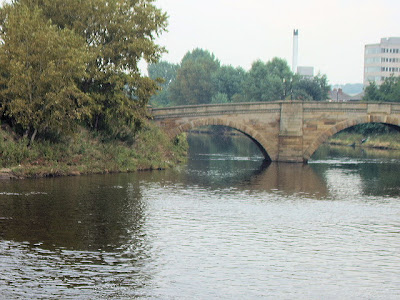
This week it was the turn of Castleford, a town suffering badly from closures of local industries, most notably pit closures, a place I'd thought of as rather sad and downtrodden. Recently there have been moves to improve the town. Amongst the things that have happened is the building of a magnificent new bridge over Castleford Weir on the River Aire near where it meets the Calder: (an historical sidenote on the two rivers - it used to be said that "Castleford ladies are beautiful and fair. They wash in the Calder and rinse in the Aire")

For once I remembered my camera. The picture above is of what used to be a local mill where flour was ground. The river was in spate (heavy rains in previous weeks) which meant that water was plentiful. Here's the mill-race which once powere the mill:


And here's the old bridge, lower down:


The new bridge is an amzing structure built of wood and very different but equally beautiful. This photograph shows only a part of it and does not really do it justice though it does show the way it curves over the river.


The wires on the sides are thick and tensioned which makes it very safe for children -no danger of falling in. While we were there there were numerous local families enjoying the view. All in all a successful piece of modern design which also has allusions to more traditional design.

Whilst I was there I managed to get some inspirational pictures of water. Here I was really pleased to be able to capture something of the patterns the water makes:


and this one is my favourite: I set out to try to capture the subtlety of the colours and the contrast between the smoothness of the water above the weir and the turbulence below, and actually managed both!

Sunday, 14 September 2008

Blog Award


Nearbytree http://mittensmum.blogspot.com sent me this award - very much appreciated and I've been blogging so little lately that I'm not sure I deserve it but will try to improve and live up to it!
At the moment I'm finding it quite difficult to think of enough bloggers that I haven't (or someone else hasn't) tagged or nominated recently. For those of you looking for a list of brilliant blogs there is a favourite blogs list attached to my profile (courtesy of new Blogger thingy). It is not yet complete - there are some to be added to.
Any of you (and any others I read regularly) may consider yourself nominated. To continue the process, what you have to do is:
acknowledge the nomination and print a link to the nominator, plus the blog award logo above;
nominate seven blogs, and add links to them;
leave a message telling people you have nominated them.
And once again, thank you very very much!

Saturday, 13 September 2008

Belatedly - Festival of Quilts

Back in the land of the living after returning from the Festival of Quilts nearly four weeks ago.
Apologies for the delay in reporting back: I returned with a cold which became a nasty bout of bronchitis followed by a further bout of general fatigue followed by a period of utter laziness!

I actually treated myself to the whole week in Birmingham, which seemed like a good idea at the time. The first three days I spent in a masterclass with Susan Brandeis about developing creative potential and designing meaningful quilts. If you ever get the chance of a class with Susan, seize it with both hands. It came at absolutely the right time for me and was exactly what I needed since - as my entries for FOQ below will reveal - my work suffers at times from lack of thought: I've tended to go with the flow rather than really thinking about and developing ideas and designs. I'll post later about how this workshop has helped me develop.

One really good thing about the workshop was the group of people I was with: really supportive people producing excellent work - though at times I did feel myself running to catch up! Here we are (minus a couple of people who had to leave early:


By the end of the masterclass I was completely exhausted and, having seen all the amazing quilts (standards have been raised colossally since I last went to a large quilt show), I felt more than a bit apologetic about mine. Still I did promise to put them on my blog and here they
are:


First of all Snakes and Ladders, finished at last. Even though there are things wrong with this I still love it: apart from anything else it's the first quilt I'd started since 2000 when my husband died so it's great to have it finished.

The second is based on pebbles and rockpools, made of silk, satin, silk organza and cotton jersey plus silk fibres, hand embroidery and machine quilting:

It did suffer through having to be finished in a hurry - serve me right for over-estimating what I could do in the time.

The third quilt is the one I was really embarrassed by - if I could have taken it down and stuffed it away and hidden it from view I would have done so. I hadn't intended to attempt anything naturalistic but it kept drifting that way - not only that but it wasn't very well designed to start with (shouldn't have skimped on that bit) so that compositionally it is dreadful. On the plus side some of the detail works really well (two of the three judges commented on the painterly use of fabric, and one liked the light in the trees so there's something to build on there).

Must remember next year to only enter things finished before the entry deadline so that I know I'm only presenting my best work to the public!

The remainder of the week was highly enjoyable. Lots of amazing quilts and exhibitions to see (afraid I don't have pictures as I had camera problems), friends old and new to meet and catch up with and went home with lighter pockets but weighed down with supplies.

Oh, and the cats really did seem to miss me - wouldn't let me out of their sight once for three weeks after coming back from the cattery but insisted on following me everywhere - even Bixy made his way up two flights of stairs to find a curling-up spot in the studio.

More catching up soon!


Friday, 8 August 2008

I did everything but take photographs

Sorry about the long delay in updating my blog. Did a silly thing. Entered not-yet-finished quilts for The Festival of Quilts confident that I'd easily finish them on time. I did (finish them I mean) but not easily.

You know how it is: you're going along to a particular timetable knowing what you're going to do and then as you do it you come up with new ideas.

The first was a small quilt based on the idea of rockpools - between the tides, where earth and sea meet. I've always been fascinated by them and the strange species which inhabit them. This one started with pebbles, translated into fabric in 3D using jersey hand-dyed and stuffed with wadding. I'd planned a simple background using a length of hand-dyed silk with dyed scrim for sand but it all got very much out of hand. It began OK with a length of scrim pressed flat over hand-dyed wadding producing a very nice dull sand colour, and the silk worked well too though somewhat inclined to fray so it needed satin-stitch. Then I discovered the viscose satin I'd dyed ages ago so that went in too; and that too frayed horrendously and needed satin-stitching. Then it needed shadows, in the form of silk organza. And of course it had to have rocks or there would be no rock-pool. By this time it had taken three times as long as expected.

I liked the seaweed made from granite stitch over silk fibre (the later seaweed, not shown in this photo was fastened to the rocks using seeding; some was stitched to a background chiffon/organza by machine and then appliqued. Then the pebbles went on by hand. And some couched hairy chenille for more seaweed.

I had all sort of plans - stumpwork shells and limpets, sea anemones, hand-embroidered feathered stars etc etc. On reflection it's probably as well I ran out of time or it could have been too far over the top!

Here it is half-way through:

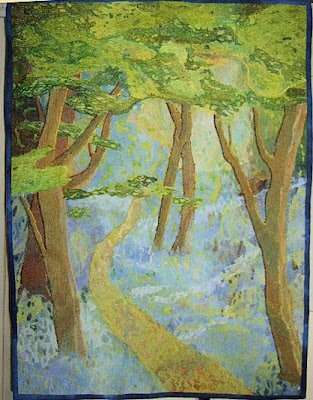
The next one is based on Wytham Woods at bluebell time. I was trying really hard to be abstract but it kept coming out naturalistic. It's made in scrim over hand-dyed wadding with layers of colour used like water-colour washes. Here it is at an early stage. This version looks better than the finiished item:

I then decided to add more layers, and experimented on some scraps with FMQ which was then cut back to give a sort of speckled effect (to suggest leaves and the blue and green of bluebell plants). When I started doing this on the quilt it became obsessive - an interesting effect but unfortunately I got so caught up in doing it that I lost one of the most important compositional features i.e. the effects of light and shade which means that as far as I remember the finished piece is comparatively static. Unfortunately I have no photograph of the finished quilt - I just hope it's better than I remember and I don't have to run away in shame and hide when I see it hanging up next week.

The third entry is the only one at this stage that I am actually confident I like - i.e. the Snakes and Ladders one I blogged about earlier. The final stages improved it immensely from the way it was when I last showed it but once again I have no photo, till I get one next week at the Festival of Quilts.

I'm hoping I learn from this not to enter anything I haven't actually finished. There is actually a chance I might stick to this, since I'm doing a lot more anyway now I have retired!

Friday, 4 July 2008

Out the Other Side

OK so here it is. It didn't get selected for the SAQA Europe show I entered it for but given the wealth of art quilters in Isreal and Europe and the quality of work those selected normally produce that is not really very surprising - I still have a very long way to go.

However it is a quilt that's important to me for several reasons. Firstly the subject-matter: the quilt celebrates finally being discharged from the cancer clinic at St James's (Jimmy's) Hospital in Leeds, where, six years ago I was treated for endometrial cancer by the most amazing team of doctors and nurses and other medical staff, to whom as you can imagine I am extremely grateful.

The patterns are based on normal and cancer cells and the sun-like thing at the top right is probably something to do with the radiotherapy treatment I had to undergo after surgery. I'm not sure where the snake-like shapes came from . My friend Judith reckons they look like snakes, which is not entirely inappropriate - the whole experience was intensely scary but snakes are also traditional symbols of survival, presumably because they can go without food or water for relatively long times.

It was also a first for me in that I've never made a full-size quilt using scrim before (the spots and blotches are the only bits on the surface that aren't); I also dyed the wadding to have colours that would show through the scrim. Plus it's the first quilt I've ever made with serious grown-up subject-matter.